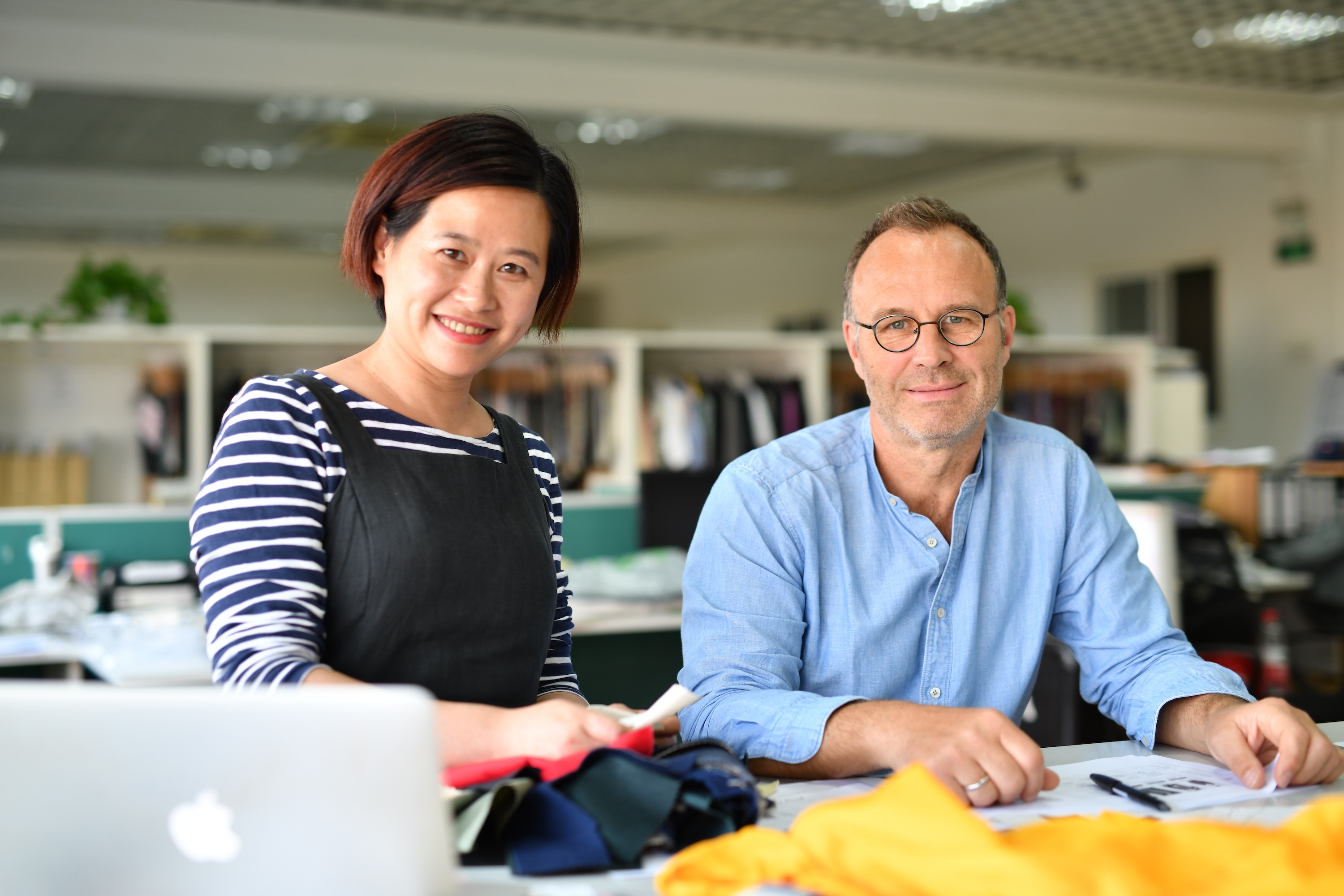
Hi Bernhard! What’s #BehindTheSeams of MELA Wear?

Have you heard of MELA Wear already? We actually already teamed up with the Germany-based GOTS-certified brand in 2024. Recently, we sat down with Bernhard Weiß, Co-Managing Director of MELA. Having joined the company’s leadership team in 2024, Bernhard brings extensive expertise and works alongside founder Henning Siedentopp to shape MELA’s continued growth. In this conversation, he shares his thoughts on informed consumption, redefining growth, and why people and nature remain at the heart of MELA’s mission.

If someone met you for the first time, what would they probably not expect about you?
Many people probably expect the managing director of a textile company to be someone who mainly talks about growth, markets and numbers. In reality, I often find myself thinking about very different questions: How do we want to live? What does a good life look like? And what kind of world are we leaving behind for future generations?
I am the father of three children, and many of the decisions I make today – both personally and professionally – are guided by the question of whether I could confidently explain and justify them to my children. In doing so, I often rely on my intuition and gut feeling.
What people would probably least expect is that I used to be the singer of a hardcore band.

What is a belief you hold that not everyone in your industry would agree with?
I believe we need to redefine what growth actually means.
For decades, growth has largely been understood in economic terms: more revenue, more products, more consumption. I am not fundamentally opposed to growth. However, I believe we need to ask ourselves a more important question: What exactly do we want more of?
Higher revenue alone does not automatically make people or companies more successful. Perhaps we need more quality instead of quantity. More durability instead of speed. More connection instead of possession.
As a father, I often think about the world we are creating for our children. If growth comes at the expense of people, communities or nature, we should question whether it is truly progress.

When do you feel most aligned – when everything just makes sense?
Usually not in the office—although I deeply value my colleagues.
I feel most aligned when I am spending time with my children or walking through the forests of Sweden. There, I have learned how little we actually need in order to be content. How little it takes to truly feel connected to ourselves.
Nature does not judge. It does not demand constant growth. Instead, it teaches us the importance of balance, patience and connectedness. These lessons strongly influence the way I think about leadership and entrepreneurship today.
This connection to nature also shapes the way I think about our products. Clothing is something we wear directly against our skin every single day. It should not only be good for the environment—it should be good for our bodies too. For me, using certified organic materials free from harmful substances is not a premium feature. It is simply the right thing to do.

From your perspective, how can brands like MELA support people in making more mindful consumption choices?
By making the right choice the easy choice.
Consumers should not have to spend hours researching supply chains or comparing certifications. As a brand, our responsibility is to create transparency, offer durable products and communicate honestly.
The same principle applies to health. Many consumers do not realise that certified organic clothing not only protects the environment, but also keeps harmful substances away from their bodies. For people with sensitive skin, allergies, or young children, this is especially relevant. We want to make that visible – not through fear, but through honest communication.
I would love to see a world in which people buy less, choose more consciously, and appreciate the things they own for longer—or give them a second life when they no longer need them.

In your view, does the fashion and textile industry need more empathy? If so, where? And what role do certifications play?
Absolutely.
Empathy is needed throughout the entire value chain—from cotton farmers and garment workers to consumers and the generations that will have to live with the consequences of the decisions we make today.
Certifications such as GOTS create important standards and transparency. They help make responsibility visible and measurable. But real transformation only begins when people are not merely following rules, but genuinely care about the impact of their actions.
Empathy also means taking the health of our customers seriously. When someone buys a MELA product, they should not have to wonder what is in it. That trust is something we want to earn—through transparency, certified quality and a genuine commitment to wellbeing.
GOTS places strong emphasis on transparency and social criteria. Where do you see the added value of personal communication and relationships beyond certification?
Certificates create trust through systems. Relationships create trust through people.
Long-term partnerships allow for honest conversations, shared learning and continuous improvement. In my view, the strongest supply chains are built not only on audits and contracts, but on mutual respect, trust and shared values.

Looking to the future: what do sustainable synergies between businesses, customers and nature look like?
The future belongs to business models that create value for everyone involved.
I also believe that clothing should actively contribute to people’s health and wellbeing, not just avoid doing harm. Imagine a world where getting dressed in the morning is not only an environmentally conscious choice, but also a healthy one. No hidden chemicals, no compromises. Just materials you can truly trust, on the skin of you and your family.
Companies should be successful because they help people live better lives while protecting, or even regenerating, natural resources. Economic success and responsibility must no longer be seen as opposing forces.
The most successful businesses of the future will not be those that extract the most value, but those that create the most value for people, communities and the environment at the same time.

What role do networks and collaborations play in driving real transformation?
A crucial one.
No company can solve the challenges of our time alone. Real transformation emerges through collaboration, through authentic connections between brands, suppliers, certification bodies, policymakers and consumers.
Sustainability should not be an area where we compete against one another. It should be an area where we make progress together.

What is one hope you have for the industry—and perhaps also for MELA—in the coming years?
I hope that sustainability will eventually stop being a niche topic or a competitive advantage and simply become the norm.
For MELA, I hope we continue to demonstrate that economic success, social responsibility and respect for nature are not contradictions. If we can inspire others to follow the same path, we will have achieved something truly meaningful.
And on a very personal level, I hope that one day my children will be able to say:
“You didn’t get everything right, but you acted with integrity and genuinely tried to make a positive difference.”

Let’s Sit Down for a Chat about Sustainable Fashion: Inside the World of LANIUS

In 1999, Claudia Lanius set out to build a fashion brand around a clear principle: “LOVE FASHION / THINK ORGANIC / BE RESPONSIBLE.” More than two decades later, that idea remains part of the identity of LANIUS, a Cologne-based label known for its distinctive design and focus on material choices.

Today, Claudia is joined by Annabelle Homann, her daughter and the brand’s Managing Director, bringing another generation’s perspective to the business. Together, they navigate the practical decisions involved in sourcing materials, developing collections and maintaining long-standing relationships with suppliers while continuing to evolve the brand.

In July, Susanne Diener, Global Standard Regional Representative for Germany, Austria and Switzerland, met Claudia and Annabelle at the LANIUS headquarters in Cologne.

Their conversation explores the personal motivations behind the brand, how its approach has developed over time, changing consumer expectations and the practical realities of working with materials, sourcing and GOTS-certified textile production.

For Claudia and Annabelle, the discussion is an opportunity to reflect on the role certification plays within LANIUS, the decisions involved in putting the brand’s principles into practice and how their approach continues to develop as the fashion industry changes.

Watch the full video to hear directly from Claudia, Susanne and Annabelle: 

Redefining Strength: The Power of Soft Leadership in Fashion

Rethinking Leadership in Fashion

Traditional ideas of entrepreneurship often associate success with assertiveness and dominance. Miranda Chen, co-founder of LangerChen and Jiecco, offers a different perspective: patience, empathy and resilience can be equally important in building and leading a business.
For Miranda, this approach also shapes how she thinks about environmental and social considerations in textile production. Rather than treating them simply as marketing themes, she believes they need to be incorporated into everyday business decisions.

A Different Approach to Leadership

Miranda recalls attending a business seminar in China where she was the only woman in a room of men. The experience highlighted for her the continuing underrepresentation of women in some senior business environments.
Rather than adopting a more traditionally masculine leadership style, Miranda has focused on qualities such as patience, emotional intelligence and adaptability. She believes listening, collaboration and a long-term perspective can be powerful leadership tools.

Her approach extends to the people involved in the business. From sewing staff to fabric suppliers, Miranda emphasises recognising each person’s contribution. She also points to practical measures, such as providing soft floor coverings for employees who spend long periods standing, as examples of how consideration for employees can become part of day-to-day management.

Her advice to young women entering textiles is similarly practical: think about environmental and social considerations from the beginning, build strong relationships with suppliers and manufacturers, and be patient. Meaningful change takes time.

At LangerChen and Jiecco, Miranda and her co-founder, Phillip Langer, have sought to incorporate environmental and social considerations into their approach to textile production.

GOTS provides a defined framework for textile processing and manufacturing. It covers stages after raw fibre production and includes requirements relating to certified organic fibre inputs, chemical inputs and processing, environmental management, and human-rights and social criteria. Compliance with applicable GOTS requirements is independently assessed and certified by accredited third-party Certification Bodies.

For Miranda, certification has provided structure and accountability:
“At first, I resisted certification. I thought, ‘I know I’m doing the right thing, why do I need proof?’ But over time, I realised that GOTS is not just about compliance—it’s about education, accountability and credibility. It helps businesses improve, step by step.” – Miranda Chen

For her, leadership and certification serve different but complementary purposes: leadership shapes the choices a business makes, while certification provides defined requirements and independent assessment.
“Sustainability isn’t about achieving perfection overnight. It’s about continuous progress. That’s what GOTS helps us do.” – Miranda Chen

Miranda’s experience shows that leadership does not have to be loud or dominant. Patience, empathy and collaboration can offer another way to lead—and another way to build a textile business around clearly defined values.


SAFO BY HEART: UPCYCLING AND THE POWER OF GOTS CERTIFICATION

SaFo by Heart is a recently launched brand from a textile manufacturing company in Kochi, Japan. The company incorporates practices including the reuse of manufacturing scraps and offers GOTS-certified organic textile products.

SaFo by Heart uses scraps generated during bedding manufacturing to make cloth packaging and other products. The company has also introduced measures to monitor waste and emissions associated with its operations.

GOTS provides requirements for the processing and manufacturing of textiles made with certified organic fibres. It covers stages after raw fibre production, including first processing, manufacturing and trading. Compliance with applicable GOTS requirements is independently assessed and certified by accredited third-party Certification Bodies.

We spoke with SaFo by Heart’s leadership about the company’s development, its experience with GOTS certification and the practices it has introduced alongside certification.

Global Standard: Can you tell us a bit about SaFo by Heart and the story behind its creation?

Hiroaki Yamaoka:

SaFo by Heart grew out of our experience manufacturing bedding and textiles. We are a factory brand of a manufacturing company located in Kochi, founded in 1988.

One area we have focused on is making further use of materials generated during manufacturing. For example, we use scraps from the bedding manufacturing process to create cloth packaging and other products. Instead of discarding these materials, we look for ways to use them in new applications.

Global Standard: Why did you choose to pursue GOTS certification, and how does it align with SaFo by Heart’s values?

Hiroaki Yamaoka:

We wanted a defined framework that addresses requirements relevant to textile processing and manufacturing.

GOTS provides requirements covering areas including chemical inputs, environmental management and social criteria within its certification scope. For us, working within these requirements provides a structured framework for reviewing our manufacturing practices.

GOTS applies to textile processing stages after raw fibre production. Compliance with applicable requirements is independently assessed and certified by accredited third-party Certification Bodies.

Global Standard: How has GOTS certification impacted SaFo by Heart’s practices?

Hiroaki Yamaoka:

Maintaining GOTS certification involves regular assessment against the requirements of the Standard. This has provided us with a framework for reviewing different aspects of our operations.

Separately, we work with a university to measure CO₂ emissions associated with our production. We also calculate waste and emissions data and display this information at our factory and offices so that it is visible to our team. We use this information to monitor our performance and identify areas where we can make changes.

GOTS certification has also become an important part of how we communicate about our organic textile products in Japan and internationally.

Global Standard: What are some of the tangible benefits SaFo has experienced since obtaining GOTS certification?

Hiroaki Yamaoka:

For our clients and consumers, certification provides independently assessed information that specified products comply with applicable GOTS requirements.

Internally, the Standard provides a defined set of requirements against which relevant aspects of our manufacturing operations are assessed.

Alongside certification, we continue to look for ways to make use of manufacturing scraps. One example is our cloth packaging, which uses material that would otherwise have been discarded during our bedding manufacturing process. Finding additional uses for these materials has become an important part of how we approach product and packaging development.

Global Standard: Looking to the future, what are SaFo by Heart’s goals, and how does GOTS play a role in achieving them?

Hiroaki Yamaoka:

We plan to continue developing our product range while maintaining GOTS certification for applicable products.

GOTS provides a consistent programme for textile processing and manufacturing after raw fibre production. As we develop new products, its requirements will continue to provide a framework against which relevant processing and manufacturing activities can be independently assessed.

We also hope that sharing our experience will help other textile businesses understand what GOTS certification involves and how its requirements are applied in practice.

Conclusion

SaFo by Heart combines textile manufacturing with practices including the reuse of production scraps and the monitoring of operational waste and emissions.

For its GOTS-certified products, the applicable textile processing and manufacturing stages are assessed against the requirements of GOTS. Compliance with those requirements is independently assessed and certified by accredited third-party Certification Bodies.

SaFo by Heart’s experience provides a practical example of how a textile manufacturer can integrate GOTS requirements into its operations while developing its own approaches to material use, measurement and product development.

100 years of knowledge: One brand’s generational views on making textiles

For nearly 100 years, craftsmanship and attention to detail have been part of Sankei Meriyasu’s approach to garment making. With its long history in the textile industry, Sankei Meriyasu combines traditional techniques with seamless knitting technology to produce luxurious and comfortable knitwear.
The company also produces GOTS-certified products. GOTS applies to textile processing and manufacturing stages after raw fibre production and sets requirements covering specified environmental, chemical and social criteria within its scope. Compliance with applicable GOTS requirements is independently assessed and certified by accredited third-party Certification Bodies.

GOTS recently spoke to Sankei Meriyasu President and Representative Director Tokuo Miki and his children, Yasuko Miki and Ken Miki. Bringing perspectives from different generations in the fashion and textile industry, they shared their views on current trends, sustainability, their brand, the future and more.

GOTS: Can you talk about the wide range and trends of fashion in Japan?

Yasuko/Ken: Japanese fashion is globally recognised for its diversity, ranging from genres like Comme des Garçons, Yohji Yamamoto and NIGO’s Ura-Hara style to Uniqlo’s basic fast fashion. However, there are many other options within Japan that are less known internationally. These include designer brands and domestic SPA (specialty store retailer of private label apparel) brands that are affordable and trend-conscious. Among these, factory-origin brands also form a distinctive genre within Japan. Each generation enjoys self-editing and personalising their style, even within the same brand, reflecting the diversity of Japanese fashion.

Tokuo: There are products at many different price points, and a large proportion of clothing sold in Japan is produced overseas. I see the current situation, where a large amount of clothing is made for short-term consumption and fleeting styles, as reminiscent of the monoculture era in different countries where they produced sugar and other luxury goods.

GOTS: How do you see the younger generation today thinking about environmental and social issues in their everyday lives?

Yasuko/Ken: The younger generation is vocal about their values and preferences, using new platforms to express their thoughts and emotions. They don’t just act but also share their ideas and look for others who share their views. From our perspective, questions about environmental and social issues are becoming a more visible part of these conversations.

Tokuo: Many people believe that the current situation will continue indefinitely, so I think few young people feel the difficulty of sustaining it. However, in Japan, practices within families, such as not leaving food unfinished and using things completely, have been ingrained from a young age. I think these are valuable habits to carry forward.

GOTS: What are some tips for anyone thinking more carefully about the textiles they choose and use?

Yasuko/Ken: There is no need to force it into your life. Instead, choose items that you genuinely like and want to use for a long time. Being interested in the stories and backgrounds of the things you buy can also help you learn more about how they were made. It’s our responsibility to continue creating and sharing those stories.

Tokuo: Continue using things you like. Avoid being swayed by momentary pleasures.

GOTS: You have another brand that focuses on high-quality basics. What makes Eiji “the perfect” T-shirt for you?

Yasuko/Ken: For us, the Eiji T-shirt is special not only because of its production background and the soft, comfortable fabric created by skilled artisans, but also because it can be customised to the individual. Unlike conventional T-shirts that are pre-made to standard sizes, the Eiji T-shirt can be tailored to the wearer. The ability to repair the T-shirt and continue wearing it over time is also an integral part of the Eiji philosophy.

Tokuo: I believe it’s because it’s a T-shirt that the craftspeople who make the clothes most want people to wear and trust to be good.

GOTS: Sankei Meriyasu has a nearly 100-year history. What changes have you seen, and what has inspired you to maintain the company’s approach to quality over the years?

Tokuo: When I inherited Sankei Meriyasu as the third generation, the work of making clothes domestically in Japan was gradually decreasing, with production in China increasing, making it a declining industry domestically. In such circumstances, together with skilled craftspeople and cooperating factories, we have struggled to change how and what we make to adapt to the times and somehow keep the factory running.

However, in order to maintain the factory, I have always felt that “making money doesn’t justify everything” and “I don’t want to make clothes that make people unhappy.” As a result of continuing to make clothes with these feelings despite the difficulties, 100 years have passed. That is my honest impression.

GOTS: Ken and Yasuko, what was it like growing up around this company? What did you see and learn from being in this environment?

Ken: Growing up, I remember our factory as a lively and welcoming place. I enjoyed seeing people working together, including collaborations with workers from other factories. Growing up in this environment allowed me to see the care that goes into making products and gave me a strong sense of community.

Yasuko: Honestly, when I was little, I didn’t fully appreciate how valuable the workshops and factories we work with were. The employees and workers were always very friendly and would compliment me, so it was fun to hang out at the company. Now, I feel incredibly fortunate and grateful to have them as part of our team. Their dedication is central to the quality of the garments we make.

My grandmother, who worked at our company until she was 80, inspired me immensely with her hard work and impeccable style. She’s the most stylish grandmother I’ve ever known, and she definitely motivated me to work hard and dress well.

GOTS: Yasuko, you now live in the U.S., giving you a different perspective on the fashion world. From your experience, how do conversations about environmental issues and fashion differ between Japan and the U.S., particularly New York?

Yasuko: From my personal experience, these topics seem to be more visible in everyday conversations and shopping in New York. For example, I see organic cotton products and second-hand shopping frequently. Thrift shopping is particularly visible here.

In Japan, I think there is an opportunity for consumers to learn more about how textiles and garments are produced and about their environmental impacts. I also see more of these conversations taking place among younger people through social media.

GOTS: Do you see the relationship between nature, cities and textile traditions differently in the two places?

Yasuko: In Japan, there are many artisanal textile and garment producers with specialist skills and long-established production techniques. Some of these skills are at risk of disappearing because producers cannot find successors. I think it’s important for people in Japan and elsewhere to understand these skills and the work behind them.

In New York, I see a strong emphasis on innovation and new approaches to urban living, from rooftop gardens to developments in fashion and materials. I think there are interesting ideas and experiences that people in Japan and New York can learn from each other.

GOTS: Where do you see the company going in the future?

Ken: We create unique clothes that only we can make, and we now have the means to share this with the world. We’ve realised that if we create what we truly want to make and share it globally, there will be people who appreciate and need it. This makes us very optimistic about the future. We are focused on preserving and passing down the techniques of our predecessors to the next generation with a strong sense of purpose.